
Cancer in Prison: A Death Sentence?
All around us, authorities work to steal our life force. I won’t let them take it in the time I have left.
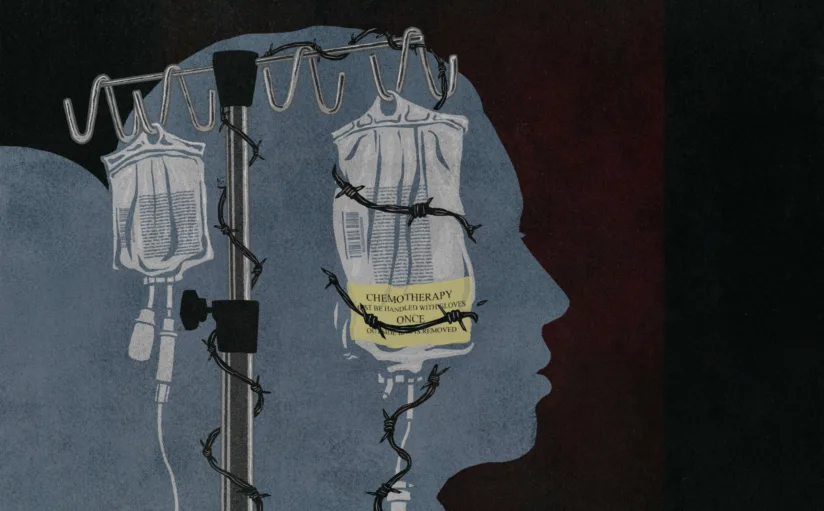
This essay is a 2026 winner of the Keeley Schenwar Memorial Essay Prize, republished from Truthout.
How did my prison doctor miss a tumor the size of a doll’s head on my ultrasound? Why did I get cancer? I had been imprisoned at Perryville in Goodyear, Arizona, for 14 years — most of which were spent as a tutor, helping hundreds of women obtain their GED. So why me?
It turns out I was asking all the wrong questions back then, before my colon cancer spread.
When you are a cancer patient and a prisoner, you aren’t allowed any second opinions or alternative treatments, or even the right to refuse any of it. If you do, all treatment is terminated.
After the surgeon removed my tumor, my stomach looked like a horror movie connected by twelve inches of staples and yellowish pink flesh. He instructed me to keep my wound clean, but the correctional officers assigned to me refused to let me shower for seven days. Although there was a shower in my hospital bathroom, I had to take a birdbath while shackled. I was also denied any food for the first five days.
Any pushback against any order resulted in petty retaliation from the officers. For example, after questioning them about my basic human rights to a shower for wound care, I was denied access to the toilet. The female officer made me hold it for so long that I soiled myself and was forced to wear Depends for the rest of my hospital stay.
When the doctor released me, the only available transport vehicle was not outfitted for human passengers. Against my objection, I was made to ride in a windowless kennel for prison dogs. There were no seatbelts, which meant every hard turn or stop sent me slamming into the aluminum walls. For the first time I became claustrophobic.
Reflecting later on this traumatic ride, I also began to question the humanity of our Constitution. Specifically, the 13th Amendment classifies prisoners in the same category as livestock property — so, why should we be surprised that correctional officers assume the right to treat and transport prisoners as animals?
So many of our bodies are undernourished, struggling to survive even when cancer is not attacking our systems.
By the time I finally returned to Perryville, I threw up in an oil drum. Because I had just undergone major surgery, I struggled to undress at the “strip shack,” where we must show our private parts to a female officer. This particular officer had a bad reputation for bullying prisoners and my sluggishness irritated her. She let me know it. As she searched my underwear, she stared disgustedly at it.
“Your chonies are stained,” she said, shaming me in front of another prisoner.
The stain was the direct result of another officer trying to humiliate me, and it was happening all over again. But I was too exhausted and in pain to care about the condition of my panties. I said, “I have stage three cancer and I don’t give a shit.”
Angered, she fixed me with a stare, roaming over every inch of my nakedness, leering repulsively at my body with such violation that it felt like assault — like someone had lopped off my private parts and freewheeled them into the trash can. While I was naked, vulnerable, and helpless, another woman weaponized her authority over me. I wanted to run, to disappear, but all I could do was look away from her glare.
On the upper corner of the wall was a sliver of light reflected from an unseen crack, and the wind outside made it appear as if the light was dancing. Pure, distilled beauty. It was free and I was not, so my eyes desperately clung to it.
Out of the corner of my eye, I could see the guard scrutinizing my scar like a grotesquery of spoiled meat, and I could feel the tears welling behind my eye sockets. I fixated wholeheartedly on the shimmering little light as though it was guiding me, showing me another way out. Suddenly I thought about the light spectrum, running to infinity in both directions. For all the darkness this guard wielded on me, it was not all-encompassing. There was also the divine spreading out three-dimensionally in light waves in the opposite direction.
I did not give her a single tear, and when she was denied an emotional reaction, she let me dress and leave.
Later on in the shower, I cried from a place deep beneath my heart where secrets hurt and indignities scream unheard into an empty black oblivion. I cried because I have a 22-year sentence and if I don’t give my pain an emotional outlet, I will die by slow suicide, giving the prison my life force.
The curious thing about that officer’s behavior is that it isn’t isolated to the prison staff. I also experienced intentional cruelty from the medical system during my third session of chemotherapy. I watched as the head nurse dropped a heavy bag of medical ice on the needle in my vein from a foot above it. The pain instantly turned my eyes into bright blue pools and the tears slipped quietly down my face. I don’t know why she did it, or why she did not apologize, or why the officers who accompanied me simply looked on, as though my vein deserved it. I suspect that there still exists a herd mentality among the masses who believe prisoners deserve to be punished because they’re “bad people” or “unrighteous,” while the non-incarcerated see themselves as “good” or “righteous,” thus disguising their cruelty as justified. Or, they simply abuse their power because they can. All around us, authorities work to steal our life force.
I want to be remembered as a spontaneous shimmering light, dancing and free.
When I was a child, my pet was blinded in one eye by the neighborhood bully’s BB gun. After he took both of her eyes, there was something missing in them beyond sight that she never got back, and she died shortly thereafter. What he stole from her I don’t know exactly, but I recognize it everywhere here in prison, as if many of the women themselves have been stolen, and all that remains are their bodies.
And so many of our bodies are undernourished, struggling to survive even when cancer is not attacking our systems. I’m the poorest of the poor, and in prison, the impoverished are at the mercy of the chow hall. We eat the lowest-grade meats and whatever processed carbohydrates we can access, which in turn, break down into sugar, and cancer feeds on sugar. Studies actually show a causal link between conventional processed meats and colon cancer, but I don’t have the money to buy healthier foods. The water at the prison where I’m incarcerated is unfit for human consumption, and I wish I could buy bottled water. But I have 23 cents in my spendable account — not even enough to buy a bar of soap.
For about a month, I was cancer-free. Then, it spread to multiple areas in my liver. Why did it come back? Does the reason matter? I believe that, at least in part, the cancer returned because of the emotional and physical toll of the abuse and neglect surrounding my treatment, lack of treatment, and lack of adequate food during my incarceration.
Still, my life force remains. I won’t let them steal it in the time I have left.
Nowadays, while the rest of the world sleeps but I’m wide awake, I silence the grey world around me and ask myself better questions. How much life can I live in this moment? What kind of thoughts can I think today to elevate those around me? Have I made the most of the life I’ve been gifted?
If I die today, I don’t want to be remembered as another number forgotten amongst the casualties of the prison system. I want to be remembered as a spontaneous shimmering light, dancing and free.
This author is using a pseudonym.