
Deportation Dollars: ICE Contracts With More Than 1,000 Businesses Across the U.S.
The Appeal’s investigation found contracts in nearly every state and the District of Columbia. Find out if your local businesses are working with ICE.
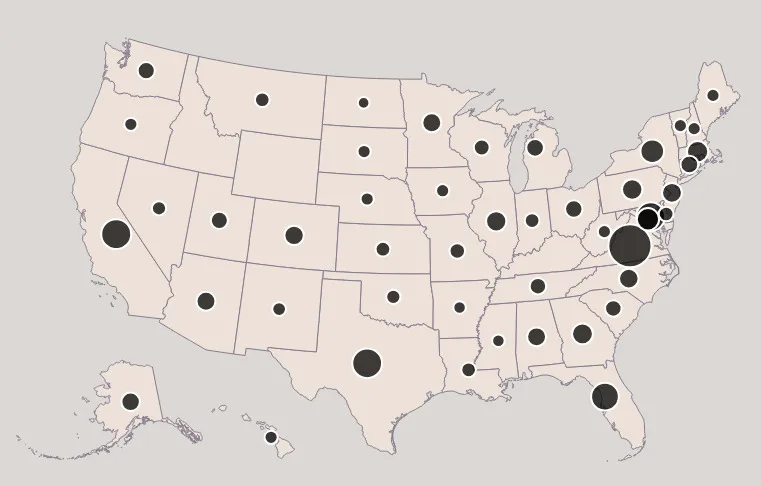
With billions of dollars to spend, the Trump administration has entered into contracts with hundreds of companies, both big and small, to execute its deportation agenda. Since January 20, 2025, Immigration and Customs Enforcement (ICE) has awarded $8.4 billion dollars to more than 1,100 companies, according to The Appeal’s analysis of data available on the government spending website usaspending.gov.
The Appeal’s investigation reveals a widespread web of public and private entities enabling Trump’s deportation machine. We’re publishing the results of our investigation in a database so users can identify companies and governments in their area working with ICE.
Find ICE Contractors Near You

Our investigation found ICE contractors in nearly every state. Use our searchable database to browse contracts in your state, county, or ZIP code.
ICE has awarded approximately $154 million in contracts for combat training, weapons, and related items, such as restraints, handcuffs, leg restraints, and belly chains. The agency also entered into contracts worth about $77,000 for “Sniper Training Equipment,” and a contract for about $19,900 with a company called ShivWorks for “Defensive Tactic Knives for law Enforcement Training courses.” Last week, the Associated Press reported that the agency was planning to purchase gloves that deliver electric shocks.
The largest recipient of weapons spending, Atlantic Diving Supply, has received nearly $100 million.
But much of ICE’s spending involves more banal goods and services essential to the everyday functioning of the agency, including approximately:
- $52 million for office furniture;
- $4.3 million for roofing contractors;
- $1.2 million for interior design services; and
- $2.1 million for parking space leases.
The One Big Beautiful Bill Act, signed into law last year, allocated $75 billion to ICE, to be disbursed over the course of four years, or about $18.7 billion a year. That funding was on top of the $10 billion Congress had already given to ICE for fiscal year 2025. ICE now has a larger budget than any other federal law enforcement agency.
In addition to private companies, ICE has also entered into contracts with several local governments.
Last year, the City of Arlington in Texas entered into an about $50,000 contract to provide the “ICE Office of Human Capital with a 3-day venue” for a hiring expo for law enforcement candidates. Earlier this year, ICE entered into a contract with the town of Lancaster, New York for “a rental of a secured parking facility … for storage and deployment of up to 164 government vehicles.”
The agency also contracted with the City of Cottage Grove in Minnesota for the rental of a firearms range facility to train law enforcement officers in the “St. Paul Area of Responsibility.” The contract was for about $118,000 and ran from August 1, 2025 through July 31, 2026. Earlier this year, immigration officers shot and killed two protesters in Minneapolis, Renee Good and Alex Pretti, in addition to shooting Julio Cesar Sosa-Celis, who survived.. Since last year, federal immigration officers have shot at least 23 people nationwide, according to a New York Times investigation.
The summary of a contract for medical supplies with Altitude Technologies states that the “the purpose of this contract award is to provide compact trauma kits essential for medical emergencies and critical incidents to enhance ICE personnel survival during encounters involving severe hemorrhage or penetrating chest wounds.”
There is no mention of using the supplies for people who are injured by ICE officers.
ICE did not respond to The Appeal’s request for comment on this contract.
Activists from across the country have launched campaigns to demand businesses, police departments, and local governments cut ties with ICE.
Last year, after ICE agents flooded Los Angeles, activists staged “No Sleep for ICE” protests outside the hotels where they were staying. Protesters banged pots and pans, chanted, and played music in hopes that the hotels would kick out the ICE agents.
“The point is to drive ICE out of these hotels, and make their existence impossible here,” protester Andrew Guerrero told USA Today at the time last year. “We don’t want them to be able to access these amenities. We don’t want our local neighborhoods to be harboring what a lot of us consider kidnappers.”
People are organizing against ICE in smaller, rural areas as well. In Arkansas, an immigrant rights group, the Alliance of Immigrant Respect and Education (AIRE), called for a boycott of the recent Tontitown Grape Festival to protest the local police department’s participation in ICE’s 287(g) program which deputizes local law enforcement officers to carry out the duties of immigration officers.
“The department’s role in providing security at the festival further heightens concerns within our community and has led many immigrant families to feel that attending the event is not safe,” the organization said in a statement, according to local news reports.
ICE’s partnerships with the private sector provide a number of “pressure points” that activists can exploit, organizer Laura Berlin told The Appeal. Berlin is a member of the De-ICE Citizens Bank Coalition.
“Zooming out a little bit, for a lot of us, it’s about fighting back against fascism broadly, but then specifically focusing on that corporate pillar of support that is behind all of this,” Berlin said.
Berlin has published a map of companies and local governments that work with ICE in an effort to help identify “leverage points where we can make a difference as just regular people.”
“We have this massive budget that is going out into the country, and I think people don’t realize how far it extends right into our communities,” she said.
According to The Appeal’s investigation, since Trump’s second term began, ICE has had contracts with companies based in 48 states.
Berlin says community members can boycott, circulate petitions, and protest “consumer-facing” companies that either contract with ICE or work with its contractors. Employees at these businesses can speak out too, as many have already done, she said.
Workers at the architecture firm DLR Group, which brands itself as a social justice minded company, demanded their company cease working with CoreCivic. In response, the company agreed to not do work for “ICE detainment or deportation facilities,” but refused to drop its current contract with CoreCivic or commit to not working with private prison companies at all, according to Mother Jones.
Private prison companies CoreCivic and GEO Group have received more than $1 billion in ICE contracts since Trump’s second term began. For the first six months of 2026, GEO Group reported total revenues of $1.44 billion, a 16 percent increase from the first six months of 2025. CoreCivic’s revenue for the second quarter of 2026 increased just over 27 percent from last year, to almost $685 million.
People detained in their facilities have reported that they are brutalized, subjected to sleep deprivation, and denied medical care.
While The Appeal’s database only includes companies that ICE has direct contracts with, the agency’s financial footprint is much larger. For instance, activists have demanded that Citizens Bank, which does not contract with ICE directly, stop financing GEO Group and CoreCivic. According to the De-ICE Citizens Bank Coalition, the bank “has played key roles helping GEO and CoreCivic access more than $2.5 billion in financing, including $100 million in January 2026.”
Numerous organizations and city councils had announced they planned to close their accounts with the bank to protest their work with the private prison industry. In July, on the eve of a planned nationwide protest, Citizens Bank said it would cut ties with GEO Group and CoreCivic, citing “changed commercial circumstances.”
Berlin says that while there is a “sense of hopelessness,” this work shows that “we are individually and collectively really powerful.”
“Across the country, we’re seeing more and more really important conversations about how the anti-immigrant agenda is hurting our communities, how local companies and law enforcement agencies may be involved, and why state and local governments’ investment and banking choices matter,” Berlin wrote to The Appeal in an email.