
Incarcerated Women in Arizona Go on Hunger Strike for Better Conditions
After a correctional officer allegedly assaulted a 20-year-old woman, as many as 200 of her fellow prisoners went on hunger strike for nearly three weeks.
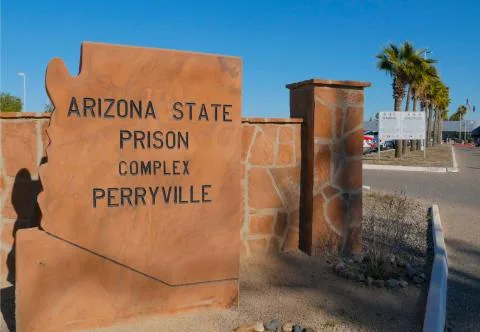
On February 1, Shajiyah X Iman called her adoptive mother “Gina” and told her about a planned hunger strike at Arizona’s Perryville prison for women. (“Gina” asked that The Appeal not publish her legal name to protect the family’s privacy.)
Iman told her that she and other women were outraged when an officer assaulted a 20-year-old woman during a routine search of her cell.
“Slicing up her sheet and body slamming her onto her bed and holding her down with the back of his arm on the back of her neck, her whole face pressed into the bed, crying and screaming for him to stop! After he was done, he slapped the handcuffs on her and yanked her up roughly off the bed,” Iman described in a message to the outside.
The incident was the final straw for Iman and others who had grown frustrated by prison officials’ failure to address poor conditions and staff misconduct. The following day, Iman helped the young woman draft a grievance. The women also began a hunger strike. She and four others drafted what they called “21 Polite Requests.” While Perryville has been plagued by ongoing issues around poor medical and mental health care, which has resulted in a federal court appointing outside oversight, the women’s requests also focused on other daily living conditions, including increased wages, reforms to the disciplinary and grievance procedures, and an end to humiliating strip searches.
For the next 18 days, Iman and others at Perryville refused food. More than 200 women may have participated at its peak. Four days into the strike, prison officials placed Iman on suicide watch and later transferred her to a mental health unit, where she remained for 20 days. On day 17, the warden and other administrators met with Iman and agreed to revise some policies, including reconsidering prison strip-search policies, and said that other revisions were already underway. They also said that Iman could meet with a member of the state’s external oversight committee.
The Arizona Department of Corrections, Rehabilitation & Reentry (ADCRR) denied that any hunger strike occurred in a statement to The Appeal. Iman, Carimbocas, and others incarcerated at Perryville, and outside loved ones are adamant that what they did was no unfounded rumor.
Iman explained that she and others wanted to act. “We were angry and really wanted to do something,” she told The Appeal. They discussed options. “We understand that we have to stop reacting violently to the violence they put on us. We tried to find a non-violent peaceful alternative that could make more change than the damage he caused,” she said.
Bayyinah Muhammad first connected with Iman six or seven years earlier. At the time, Muhammad was a receptionist at the Islamic Community Center of Tempe, where she answered requests for information and other resources from people who had recently converted to Islam in Arizona prisons.
Since then, Muhammad and Iman have maintained a weekly correspondence. Muhammad recalled that Iman told her that she was starting a hunger strike to protest not only the officer’s attack, but ongoing conditions as well.
In a February 2 electronic message, Iman told Muhammad, “Our hunger strike now has 75 women. [DOC] central office has our Polite Requests.”
Two days later, Muhammad received a message from Crystal Carimbocas, Iman’s cellmate, confirming the mass hunger strike.
On February 6, Carimbocas reached out again to Muhammad. Iman had a tele-visit with the prison psychologist. She informed her that she was on a hunger strike and directed her to the website with their 21 polite requests. Later that evening, prison officials moved her to suicide watch. She spent two days there before they moved her to a different mental health unit.
In both settings, Iman had no access to her prison tablet, which she relies on to make calls, send electronic messages, and receive digitized postal mail. Her only contact with the outside world was one five-minute phone call each week to her mother.
On February 19, Carimbocas sent a message to The Appeal confirming that she was still on hunger strike 17 days after it had started. “The Polite Requests are legit, fair and it serves justice to all people residing in here,” she wrote. “It gives hope to those that …someone is listening, that someone wants to make a change and we are all here coming together and providing that change for that someone to hear and communicate with us. That someone is The Director.”
In an email to The Appeal, the Arizona Department of Corrections, Rehabilitation & Reentry stated that there was no hunger strike and that the accusations against that staff member are false. “ADCRR staff have been in regular communication with one particular incarcerated individual at ASPC-Perryville and working to address their particular needs and concerns, but unfortunately, that has not stopped unfounded rumors from reaching you,” the media relations spokesperson wrote.
Prison historian Dan Berger noted that it’s not uncommon for officials to dismiss and deny that a hunger strike—or any other type of organized disturbance—is occurring. “The public relations strategy of the prison is to deny the testimony of the people who are incarcerated,” he told The Appeal. “Because they control access to the institution, they too often win out.”
The Appeal heard from several outside friends and family members, as well as women at Perryville, all of whom insist that a mass hunger strike occurred. Two other women confirmed their participation to The Appeal, while another woman shared messages from seven other participants.
“I have been here at Perryville for seven years and the conditions, the way of support, the way of operations is very poor. There needs to be change,” wrote one woman about her reasons for joining the strike.
Others echoed the need for change; all said they were hungry, but also motivated and determined to fight for better conditions.
“Before joining the hunger strike, I had a different opinion—that everyone in there was evil,” another woman told The Appeal. “On the contrary, most have big hearts and are good women who made mistakes, were deceived, and used…The worst part is that many of them will never be reunited with their families, they will never know freedom. That’s why I went on hunger strike: to support my fellow women, so that those who will never leave can have an easier life, so that they are valued, supported, loved, and respected.”
The ADCRR did not respond to The Appeal’s requests for clarification on hunger strikes. But according to their online prison policies, an incarcerated person is considered on hunger strike if staff observe that they have refused food for 72 or more hours.
Staff must report the hunger strike. Medical and mental health staff must assess the person. If they determine that the person is capable of decision-making, they are moved to a single-occupant cell and should be provided with regularly scheduled meals and an adequate supply of drinking water. Any food bought from the commissary is confiscated for the duration of the strike. Health services staff are required to monitor the person’s weight, intake, output, and vital signs every 24 hours.
Prison policy also states that a hunger striker “shall be informed of the medical consequences of the hunger strike and shall be asked to sign a Refusal to Submit to Treatment form acknowledging understanding the consequences.” Iman said that prison staff would not allow her to refuse or sign any forms.
Carimbocas said that she and other women informed staff that they were on a hunger strike. They said that they were not assessed by medical or mental health staff or offered any forms.
Behind bars, Berger told The Appeal, “hunger strikes are a tool of resistance.”
The largest and most publicized prison hunger strikes in the United States occurred across multiple California prisons. In 2011 and again in 2013, people incarcerated at Pelican Bay State Prison, California’s super-max prison, launched three mass hunger strikes to protest the state’s use of indefinite solitary confinement for those alleged to be gang affiliates. The strike spread, encompassing men’s and women’s prisons across California as well as private out-of-state prisons that held California prisoners. Coupled with a class-action lawsuit, the strikes won changes to long-standing policy, releasing 1,600 from extreme solitary confinement, including hundreds who had isolated for more than a decade. The ongoing strikes and ensuing publicity also reframed the issue of solitary confinement from being a punishment necessary for the “worst of the worst” to being a form of torture.
Prison hunger strikes have also taken place with far less attention or results. In 2009, thousands in four different jails in Phoenix, Arizona, went on hunger strike to protest the quality of food. In June 2014, more than 200 people detained at ICE’s Eloy Detention Center went on hunger strike demanding investigations into recent deaths as well as improved medical and mental health care.
Hunger strikes have also been undertaken by smaller groups–and sometimes individuals. In 2014, nine women in a Phoenix jail embarked upon a hunger strike to protest the low quality and often spoiled food. Men in a neighboring jail went on a solidarity hunger strike. In 2025, four men at the new ICE camp at the notorious Angola State Prison went on hunger strike to demand basic necessities, such as toilet paper, sufficient hygiene products, ample clean water, and adequate medical care.
Hunger strikers face multiple risks, including medical debilitation and possible death, as well as physical assaults from staff. A report by Physicians for Human Rights found that ICE officials respond to hunger strikes with brute force, including pepper spray, beatings, rubber bullets, and lockdowns, as well as force feeding. Hunger strikers in non-immigrant jails and prisons face these same risks.
“It’s a tactic of desperation because it means that the system has foreclosed or prevented other means of seeking change,” said Berger.
On February 19, Iman woke up feeling dizzy and exhausted. She told unit staff that she wanted to talk with the warden.
“I wasn’t sure I would make it through the meeting without falling out,” she told The Appeal.
The warden and three other administrators met with her. They said that everyone else had stopped the hunger strike. (That same day, Carimbocas had confirmed to The Appeal that she was still on strike.)
According to Iman, the warden told her that nobody had wanted to meet them for negotiations. Carimbocas later told The Appeal that no one had asked if she wanted to attend negotiations.
According to Iman, the warden stated that a member of Arizona’s prison oversight commission was scheduled to visit and would direct her to meet with Iman. The warden also stated that, though prison officials could not move a person who died until the coroner examined her, they would place curtains around that person instead of leaving the body exposed. She also told Iman that if the women could develop a substance abuse program, they would be allowed to teach it.
However, the warden said that only the state legislature could address the strikers’ requests for more systemic changes to disciplinary policy, wages, and closed custody.
Once the sun set, she broke her strike by eating lettuce, as well as a mixture of corn, carrots, and peas. The next day, Iman was allowed to call her mother.
“They kept telling her no one was striking,” Gina said. “They convinced her she was alone, even when I told her she wasn’t each time she got to call me.”
After speaking with Iman, Gina told Carimbocas, who was still refusing food, that the strike was over.
Carimbocas estimates that more than 200 people participated at the beginning, but the number fell as the days passed. “They got scared of them retaliating on them, like they did Shajiyah,” she told The Appeal.
On February 26, Iman was returned to her old unit.
“I think it was successful,” reflected Iman. “I have been blessed w/the knowledge to know that monsters can be fought. I’m grateful for my community for coming together to get requests together–most of them don’t have anything to do with us, they’re for other people.”
Although neither she nor the other women have noticed any changes, she still said, the strike showed her that “we [women] do have power. We don’t have to wait for the men to riot. We can make differences ourselves.”