
What DeFlock? Week of Action Confronts the AI Surveillance State
A Kansas activist discovered that police tracked him with Flock-style cameras after he wrote an op-ed criticizing them.
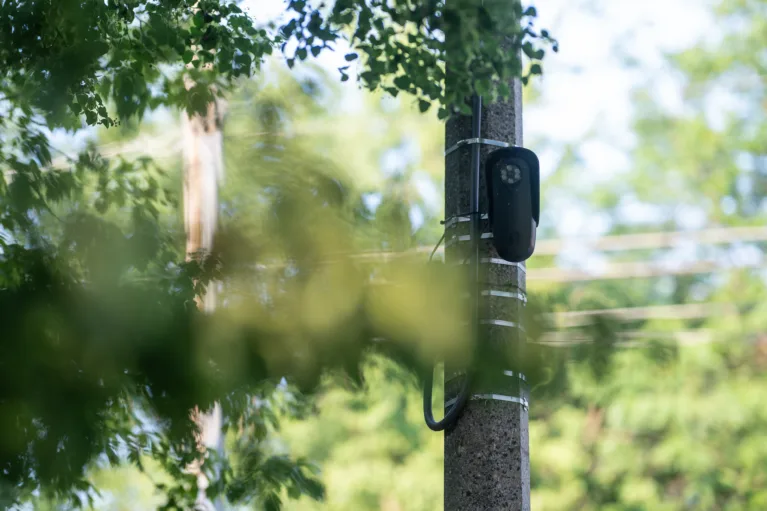
Photo by Paul Goyette via Flickr. This story was co-published with Truthout.
The op-ed Canyen Ashworth wrote last September may have been critical of the police where he lives in Lenexa, Kansas, but it could hardly be considered radical. A racist and nonsensical police investigation into the immigration status of a sitting city council member had generated embarrassing headlines, and a chaotic Immigration and Customs Enforcement (ICE) raid on a beloved local taqueria went viral. Pointing to basic reforms, Ashworth argued Lenexa’s city leaders had “work to do” in order to “meet the moment” and restore trust among residents.
“It wasn’t ACAB. It wasn’t, ‘You guys should be hung by your ankles,’” Ashworth told Truthout. “It was very much just like, ‘Lenexa, be better.’”
A few weeks later, a local reporter knocked on Ashworth’s door and said police were investigating him. An open records request revealed that a public information officer at the Lenexa Police Department distributed a copy of his op-ed to command staff the morning it was published on September 30.
At some point, Ashworth became the main suspect in a police investigation into a person the cops dubbed the “Paper Hanger” — a person wearing a hoodie who was seen on surveillance footage pasting posters to a light pole four days before Ashworth’s op-ed was published. One of the posters showed a federal agent with a vest that read “Police ICE” and “Kidnapping Taskforce,” and included the words “remember when we killed fascists.” Ashworth says he did not put up the posters — he was content writing the op-ed for The Kansas City Star.
“I personally thought they were pretty cool, like pictures of CEOs with devil horns,” Ashworth said. “People put up posters all the time and nobody really cares, but this particular brand of posters the city didn’t really like much.”
On October 21, Lenexa police sent out a “be on the lookout” alert for the suspect in the Paper Hanger case — every police officer in Lenexa was told to be searching for Ashworth. “This is MYOC,” a Lenexa city crime analyst reportedly wrote in the alert, short for “make your own case.” In other words, the police did not have evidence tying Ashworth to a crime, so officers would have to find a reason on their own to make an arrest.
“He doesn’t get out much; [his] last hit [was] a week ago today and appeared to come from McKeever’s,” the crime analyst wrote, referring to the grocery store Ashworth shops at regularly. “If you contact him (Ashworth) please note his shoes, as the suspect has only worn the ones pictured below.”
Along with details on Ashworth’s shoes and shopping habits, the alert included a photo of his car and license plate next to a separate surveillance photo of the Paper Hanger, a black-clad figure on an apparent wheat-pasting mission. Police gathered the information with surveillance cameras that are also automated license plate readers (ALPRs).
“They inferred, based on how much my car goes through the license plate readers, that it seems like he doesn’t get out very much,” Ashworth said with a laugh. “Which was like, super rude.”
Often referred to as “Flock cameras,” a reference to leading manufacturer Flock Safety, ALPR systems have been around for years but are sold with increasingly advanced capabilities and software. Surveillance is powered by artificial intelligence (AI), allowing police to combine data streams from multiple sources — including advanced drones and cameras with powerful zoom lenses that follow body movements. Flock Safety competes with companies such as Axon, Motorola Solutions, and Genetec as the market for such products grows steadily thanks to tax dollars spent by law enforcement.
The implications are serious. Ashworth said either the police read his op-ed and jumped to the conclusion that he must be the Paper Hanger — a leap of investigative logic that seems dubious at best — or they didn’t like what he had to say and made him a target for detailed surveillance with help from a network of ALPRs positioned across the town.
At no point was Ashworth arrested; police found no evidence he was the Paper Hanger, after all. Lenexa Police Chief Eric Schmitz told local NPR affiliate KCUR the investigation was related to property damage, not Ashworth’s op-ed. Ashworth filed a request for public records, including the city’s contract with Axon, and learned that his vehicle had been flagged by license plate readers 150 times in less than two years.
“They totally just leveraged the ALPR system to track me and figure out where I had been going, and to this day, I don’t know if the case was ever closed or whatnot,” Ashworth said. “But I did get interesting information from a public records request: Lenexa had 89 ALPR cameras at the time of the request, and the data retention period is two years.”
A retention period is the amount of time police are allowed to store data gathered from ALPRs before autodeletion. Advanced ALPRs identify vehicles not only by license plates, but also by make, model, color, and features such as dents and bumper stickers. Put ALPRs cameras across an entire city, as many police departments have, and cops can look back at information collected across that retention period to build a detailed profile of an individual vehicle’s daily movements.
Today there are more than 132,000 ALPRs watching traffic nationwide, including about 120,000 Flock Safety cameras. Now, as backlash to Flock cameras goes viral, Ashworth and activists across the country are speaking out and filing additional public records requests as part of a national week of action against ALPRs organized by DeFlock, a coalition of privacy watchdogs.
At least 100 local governments have ended contracts with Flock Safety and its competitors for license plate reader systems, DeFlock reports, as viral scandals helped fuel the grassroots movement against mass surveillance over the past year. In cities large and small, people are packing council meetings to ask pointed questions about what happens to data hoovered up by ALPRs: How many cameras did the police put up? Where are they? How long is the data retention period, and, crucially, who has access?
ALPRs and other surveillance tech put massive datasets in the hands of both local police as well as fusion centers, the regional multi-agency intelligence hubs that were created after the 9/11 attacks along with the Department of Homeland Security. With powerful ALPR cameras and AI-driven software, law enforcement agencies at various levels of government can share and easily search through billions of records for more nuanced details of an individual’s pattern of behavior, such as the route they take to work each day, or the addition of a new bumper sticker to a car.
“Even the name ‘automated license plate reader’ is a misnomer because they do way more than that,” Ashworth said. “It’s all this AI data center stuff; since the hardware is pretty basic, they can update the software and grossly extend the scope of what these things are able to do.”
In some cases, city leaders have responded to public outcry by simply switching from contracting with Flock Safety to Axon — without removing ALPRs from the streets. As Truthout has reported, the industry offers an ever-growing menu of powerful spy gadgets and data analysis tools for cops, including advanced surveillance drones that navigate with AI. Even as residents successfully pressure city leaders to ditch ALPR contracts with Flock and Axon, hundreds of the police departments have received federal waivers to fly surveillance “drones as first responders” that need no human pilot. At one point, Flock Safety pitched turning Uber and Lyft drivers into roving surveillance pods.
While Flock Safety originally marketed advanced ALPRs and surveillance cameras to gated communities and local police as safety tools, privacy advocates say such technology is being used to create a sweeping dragnet for the digital police state. In May, 404 Media revealed plans at the FBI to spend up to $36 million purchasing “near real time” ALPR data from private vendors to “track subjects on roads and highways” without a warrant. The Drug Enforcement Administration has operated a centralized license plate reader network in partnership with local police for years.
Police have dismissed criticism of ALPRs as “misconceptions” and “misinformation,” echoing talking points distributed in an ebook to customers by Flock Safety, according to reporting by Footnote4a.org, a project of HaveIBeenFlocked.com, a website where drivers can enter license plate information to see if ALPRs have gathered data on their vehicle. However, cops have famously used ALPRs to stalk ex-partners, track a woman fleeing the draconian abortion ban in Texas, and arrest the wrong people at gunpoint on a growing number of occasions.
Despite being marketed as a tool for police and first responders, federal immigration agencies accessed ALPR data to track people in service of Donald Trump’s violent mass deportation campaign in violation of local policies thousands of times with the help of local and state police. Activists are currently demanding that Lowe’s end contracts with Flock Safety for ALPRs placed in the parking lots of home improvement stores, where day laborers are often targeted by ICE.
Ashworth said the backlash to ALPRs is uniting people across otherwise bitter partisan divides because, in so many communities, the cameras were installed with little or no public awareness and input. Viral videos show people taking direct action by cutting down the poles ALPR cameras are mounted on — or running them over with a large truck, as one man did in Arizona.
“These companies came in and pitched their tech to these small towns, and the small towns either didn’t do their due diligence, or they were kind of misled about what the cameras actually do,” Ashworth said. “So, they kind of put it all in under everybody’s noses without their full understanding and consent, and now that people are finding out, the cat’s out of the bag.”
However, surveillance has long been a daily reality for people living in larger cities, particularly in neighborhoods targeted by police — and now advanced ALPRs are on the scene. In the Atlanta metro area of Georgia, policing and surveillance are hot-button issues in the wake of sustained protests against a police training facility known as “Cop City.”
Ikenna Ndukwe lives with his family in Brookhaven, north of downtown Atlanta, and began attending contentious city council meetings centered on a large network of Flock cameras in neighboring Dunwoody after learning that Atlanta-area police train with the Israeli military, a major source of innovation in surveillance technology. Video of one meeting went viral after a resident’s public records request revealed that a Flock employee had streamed live footage of children in a gymnastics class at a local community center as part of a sales demonstration.
“No one wants to be monitored,” Ndukwe told Truthout. “And why are the police down the street from me going to Israel to train?”
Facing public scrutiny, Flock Safety rolled out a new “Audit Assistant” tool for flagging inappropriate searches of ALPR data in April. The Georgia Bureau of Investigation also went on to arrest local police officers for misusing ALPR data in multiple cases. Nationwide, more than 100 recent cases of ALPR abuse by police have been documented by the Institute for Justice.
Flock Safety announced additional new “safeguards” last week, including requiring police to use Audit Assistant. However, critics say the tool has not been independently evaluated, and there is no evidence it will consistently prevent partner stalking and other abuses. While reformers focus on potential regulations, Ndukwe is thinking about the high-tech surveillance drones sold by Flock and other surveillance companies that police in Dunwoody, Brookhaven, and Atlanta have received federal waivers to fly.
“If they can replicate the drone strategy like in Palestine in Atlanta, then any leftist movement is dead,” Ndukwe said.
As a Black man and father, Ndukwe worries about loved ones under surveillance. He drives a custom car that is very recognizable, but, he asks, what about friends and family who do not? They are already at heightened risk of racial profiling by law enforcement without the cameras. As a member of the All-African People’s Revolutionary Party, an international pan-Africanist outfit, Ndukwe makes regular visits to Nigeria, where comrades share stories about the challenges of organizing under the watchful eye of a police state. He fears that is now the reality in the United States.
“Atlanta is a place where everyone thinks Black people have it figured out, but I look at this place as ground zero for ‘look at what we can get away with’ in terms of surveillance,” Ndukwe said. “If Atlanta is dead, if Atlanta doesn’t figure it out, we’re done. It is the biggest deterrent to any type of organizing that the government could possibly do.”
However, during this week of action against ALPRs, Ndukwe said he has been inspired by people with different political backgrounds finding common ground in the growing movement against mass surveillance, which is sending a clear message to politicians in both parties.
“You got people who are conservative, you got people who are in favor of state repression to some extent … but they are like, ‘Yeah I don’t f*** with the Flock thing,’” Ndukwe said. “People that I wouldn’t necessarily align myself with ideologically are like, ‘Brother, we can agree that we don’t like Flock?’”
For citizens-turned-privacy activists such as Ndukwe and Ashworth, the conversation is moving beyond Flock-style cameras to a broader critique of the mass surveillance state, which is growing rapidly under Trump and allied oligarchs in Big Tech.
“It’s a thousand percent fascism; I also say it’s like McCarthyism in the 1950s,” Ashworth said.
Asked in an email whether the City of Lenexa would offer Ashworth an apology for putting him under surveillance, Mayor Julie Sayers pointed to previous comments claiming she had no knowledge of the investigation into the Paper Hanger, which began before the op-ed was published.
“You need to put the guardrails in place before you get anywhere near this kind of thing, rather than kind of patch your way into this and say, ‘Oops, sorry I violated your civil rights but here’s a cookie,’” Ashworth said.
In Lenexa and beyond, the backlash has sparked debate over whether activists should push for restrictions on how police use ALPRs and store the data, or demand that Flock-style police cameras be banned altogether. Proponents of the latter solution point out that police have flouted laws and regulations, which have not been an adequate safeguard in protecting civil liberties.
Either way, Ashworth said the cameras must be taken down while the community decides next steps. If police are allowed to continue using ALPRs, then the problem will never be fixed, Ashworth said.
“I would rather not have ALPRs at all … but if we are going to have to have them, then it’s going to be on our terms, rather than some random company that buys a councilperson lunch,” Ashworth said.