
Pennsylvania Supreme Court Strikes Down Mandatory Life Sentences for Felony Murder
Last week, Pennsylvania’s highest court ruled that automatic sentences of life without parole for people charged under the felony murder doctrine constitute “cruel punishments” under the state constitution.
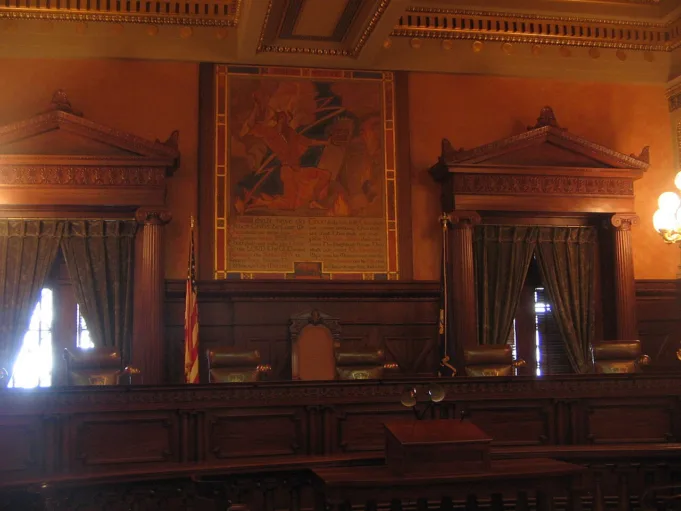
Last week, the Pennsylvania Supreme Court struck down the state’s mandatory punishment of life without parole for felony murder, ruling that it violates the state’s constitutional prohibition against “cruel punishment.”
Under the felony murder doctrine, all participants in a felony can be charged for murder if a death occurs during the commission of the crime—even if the participant was not present and had no knowledge that a death would occur.
More than 1,000 people are serving what is now an “illegal sentence,” Bret Grote, Legal Director of the Abolitionist Law Center (ALC), told The Appeal. More than two-thirds are Black.
ALC, along with Amistad Law Project and the Center for Constitutional Rights, brought the case on behalf of Derek Lee. In 2014, Lee’s accomplice shot and killed a person during a robbery. Lee was upstairs during the incident; his accomplice and the victim were in the basement. He was convicted of felony murder and sentenced to life without parole (LWOP) as required by state law.
Pennsylvania’s highest court ruled that imposing a sentence of life without parole “absent an assessment of culpability” violates the state constitution’s prohibition against “cruel punishments.”
“We are overjoyed for the hundreds of people in Pennsylvania who will be reunited with their loved ones as a result of this decision,” said Nikki Grant, Co-Executive Director of Amistad Law Project, in a statement. “We look forward to welcoming beloved community members back home as quickly as possible.”
Governor Josh Shapiro, who filed a brief in support of Lee, welcomed the ruling.
“I have long believed this law is unjust and wrong,” he said in a statement. “Common sense and true justice dictate that we need different penalties for different conduct.”
The judges paused their ruling for 120 days to allow the state legislature time to enact legislation that complies with the court’s ruling. The day after the ruling came down, elected officials and advocates gathered outside City Hall and called on the legislature to act.
“This has been quite a while in the works,” State Sen. Sharif Street said at the press conference. “The Supreme Court of Pennsylvania affirmed what many of us already knew. The sentencing regime around second-degree murder, felony-murder, is unconstitutional. It doesn’t make sense. It must be corrected.”
Sen. Street has introduced Senate Bill 387, which provides every person convicted of second-degree murder an opportunity to seek parole after they have been incarcerated for a certain number of years. Felony murder is defined as second-degree murder in Pennsylvania’s criminal code.
“This is my fifth successive session of introducing this legislation, and the General Assembly now has 120 days to adopt it,” Street said.
Grote says that if lawmakers fail to pass legislation, Lee will be resentenced, and another case will have to be brought before the court to determine if the decision applies to the more than 1,000 people already serving LWOP for felony murder. The judges wrote that the “only question before us is the constitutionality of [Lee’s] sentence,” and so they “decline to address questions of retroactivity.”
Grote says if another case is brought before the court, he’s “confident” that the judges will rule that the decision in Lee applies retroactively.
“It cannot be the case that as of this morning, more than 1,000 people are serving unconstitutionally imposed life without parole sentences, but they are not entitled to any legal relief,” Grote told The Appeal on the day of the ruling. “That is just something that the law and this court and our communities will not tolerate.”
Forty-eight states and the District of Columbia have some sort of felony murder law on the books, according to Yale University’s Felony Murder Reporting Project. The research hub has investigated thousands of felony murder cases, but says the number of convictions is unknown.
Advocates and journalists have exposed numerous cases that illustrate the cruelty of the felony murder doctrine. In 2019, three young people were charged with the murder of their friend, Jacob Harris, who was shot and killed by a police officer. The Appeal’s 2023 investigation sparked a movement to free the young people, who were sentenced to spend decades in prison. The officer was not charged.
Earlier this month, after public outcry, including a plea from the victim’s daughter, Alabama Governor Kay Ivey commuted the sentence of Sonny Burton to life without parole, just days before his scheduled execution. In 1991, Burton and others participated in a robbery of an Auto Zone store. After Burton left the store, one of his accomplices shot and killed the victim.
Advocates hope that the court’s decision sparks necessary reforms to felony murder laws and is a bellwether for the eventual abolition of LWOP, which opponents refer to as death by incarceration.
In 2024, more than 56,000 people were serving LWOP sentences, an increase of almost 70 percent from 2003, according to a report by The Sentencing Project. More than 5,000 of those people are serving out their sentence in Pennsylvania prisons. Approximately half of all people serving LWOP in the United States are concentrated in five states: Pennsylvania, Florida, California, Louisiana, and Michigan.
Grote said that the state Supreme Court’s “historic” decision is “a partial success in our efforts to end death by incarceration for everybody.”
“It is a human rights violation,” he said. “It should not be permitted anymore.”